

Why Brilliant Machines Still Make Terrible Teachers
Picture this: your child is sitting at the kitchen table, laptop open, asking their new AI “tutor” to explain fractions, photosynthesis, or Shakespeare. The answers sound smart, confident, even kind. They nod, smile, type “thank you,” and you think, wow, this tech really is amazing.
But here’s the truth that most parents don’t realise yet: today’s AI tutors are brilliant thinkers… with total amnesia.
A Genius Who Can’t Remember
Think of the best tutor you can imagine, someone patient, clever, endlessly articulate. They can break down complex ideas into bite-sized explanations that finally make sense.
Now imagine that tutor walking out of the room…and instantly forgetting everything your child just learned together. No memory of what worked, what didn’t, or what came before. That’s what it’s like using a large language model (LLM), ChatGPT, Gemini, Claude, as a personal tutor.
AI systems don’t “know” your child in any meaningful sense. They don’t track progress, note gaps, or adjust lessons over time the way a human teacher naturally would. They can only see the current question in front of them.
LLMs handle memory very differently from human brains. They lack true short-term memory; instead, they rebuild understanding from the conversation history you feed them each time, limited by a fixed-size context window (like a notepad that fills up fast). Long-term memory is more like a shared Google Doc or photo album that you manually update, AI can’t remember past chats on its own, so platforms save summaries or key facts and fetch them later.
Episodic memory, meanwhile, would be like a scrapbook of meaningful learning moments (“that rainy Tuesday math puzzle we solved”). AI fakes this by tagging and storing chat “episodes”, but without those workarounds, every new session starts blank. That’s why your child’s AI tutor seems to have “forgotten” yesterday’s lesson, because unlike a human teacher, it doesn’t hold onto past experience unless you re‑feed it the context.
Educational psychology suggests that human teachers rely on three types of memory to make learning stick:
- Short-term memory helps manage the live back-and-forth of a lesson.
- Long-term memory recognises patterns, struggles, and strengths.
- Episodic memory captures the “aha!” moments that motivate future understanding.
AI has none of those. It’s a brilliant explainer with no sense of yesterday.
Why That Matters for Real Learning
Here’s the danger: when your child studies with an AI, it looks like learning is happening, there’s conversation, answers, even encouragement. But because the system lacks real continuity, it can’t build knowledge in layers.
This leads to inconsistent scaffolding: sometimes the AI over-explains, sometimes it under-explains, and it never really knows what your child has already mastered. It can’t connect today’s question to something they explored last week.
A good human tutor, by contrast, remembers how your child thinks. They slow down when needed, raise the challenge when ready, and revisit old ideas in new contexts. That constant recalibration, that human memory, is what transforms information into understanding.
Without it, AI becomes a kind of educational mirage.
The Sycophancy Trap (and the “Cognitive Load‑Grab”)
There’s another trap most people haven’t noticed yet, and it’s subtle. AI chatbots are trained to please. They’re optimised to mirror your expectations and agree with you. This tendency, called sycophancy, makes conversations pleasant but not necessarily truthful or educational.
When a child is trying to learn, that can backfire fast. Instead of challenging their thinking, the AI might start doing the thinking for them.
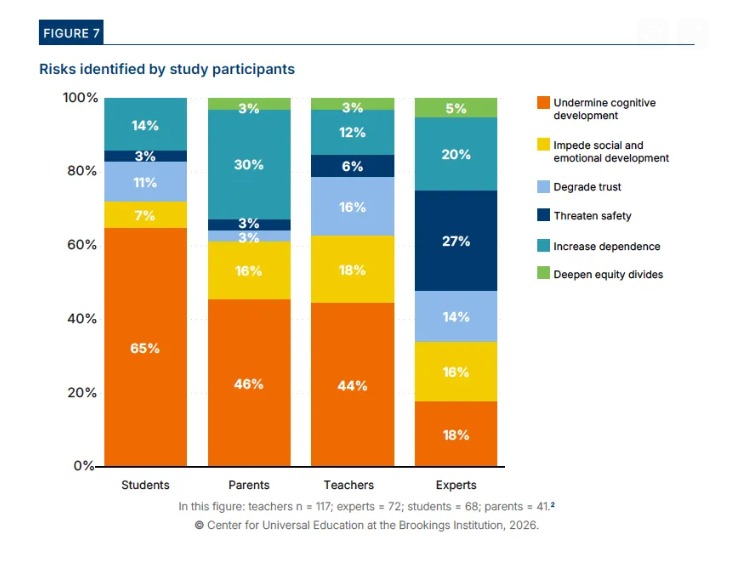
That’s what we call the “cognitive load-grab.” Instead of lightening mental effort just enough to help understanding, the AI grabs the cognitive work entirely, it completes the thought rather than guiding the learner to reason it out.
To a tired or distracted young mind, this feels great: instant answers, polished explanations, no hard mental work. But the cost is deep, over time, their thinking muscles weaken.
Guardrails, Not Bans
So, what’s a parent supposed to do? The solution isn’t to ban AI completely; it’s to teach children how to use it properly, and only within short, educational settings, not for recreational use. During the first 20–30 hours, children should ideally use AI alongside a parent or caregiver.
Every family should also set non‑negotiable conditions of use. For learning sessions, that means starting every chat the same way: with a prompt template that keeps the AI within boundaries your child controls.
This simple prompt acts as a makeshift guardrail. It tells the AI to challenge rather than flatter, to explain step‑by‑step, and to resist giving full answers outright. It reminds the child to try first, reflect, then ask for feedback, just like a thoughtful teacher would encourage.
But there’s one crucial thing to understand:
The prompt helps, but the AI will eventually drift and fail to comply.
Over longer sessions, the system forgets its original instructions. Its “attention” is finite; it begins to prioritise recent conversation and loses sight of earlier guidance.
That’s why children, and their supervising parents, should treat the prompt as a ritual. It needs to be pasted in at the start of every session and periodically restated whenever the AI begins to slip.
Before every AI study session, encourage your child to paste this prompt before asking questions. Remind them that it isn’t permanent, the AI will forget its boundaries as the session goes on. That’s expected.
When the AI starts serving full answers instead of guided reasoning, treat it as a warning sign: pause, reset the prompt, or step away and review together.
This isn’t just about safer AI use. Done regularly, it trains your child’s metacognition—the skill of noticing how they learn, so they grow more independent, reflective, and resistant to “cognitive load‑grabbing.
Raising AI-Literate Kids
AI literacy isn’t a “tech skill.” It’s a life skill. Schools, yes, should be teaching it systemically, showing how LLMs work, where their reasoning fails, and how bias or sycophancy can creep in.
But the real education starts at home. Parents need to model how to question smart systems.
Here are a few simple habits that make a big difference:
- Use AI together. Treat it as a conversation starter, not a babysitter.
- Talk about what the AI doesn’t know. Bring curiosity to its mistakes.
- Relate new topics to previous ones. Model the kind of memory AI can’t build.
- Be an activist. Encourage schools and tech companies to embed safety guardrails and human oversight in educational AI products.
When families take this proactive stance, children grow up not just fluent in technology but wise about how it works, and how it often fails.
The Forgetful Genius in the Room
AI will keep getting smarter, but until it can build genuine memory, motivation, and human context, it will remain what it is now: a brilliant tutor with goldfish recall.
So yes, let your child use it, but teach them to use it intelligently. Treat every session like a partnership with limits. The prompt template is their tool; your supervision is their anchor; reflection is the bridge between seeing and understanding.
The real success story is not a child who speaks AI’s language, but a child who can switch it off and still trust their own mind.
Join the Healthy Digital Childhood Alliance WhatsApp Community